


Jesus calls us to follow Him. Walking with Him over the course of a lifetime takes pace, pattern, and practice.
Find your RHYTHM.
What is RHYTHM?
RHYTHM is a tool to help you follow Jesus. It exists to resource you to build a healthy, sustainable RHYTHM of practices which keep you walking close to Jesus for the long run. We are formed by the things we do consistently, not sporadically, so if we’re serious about living as Christians, we need to build habits, disciplines, and practices into our lives to keep us on track.
We are all created as beautifully different individuals, and our lives are so varied that even though we are all following the same Jesus, how we do so will play out in very different ways. RHYTHM will help you to build a bespoke pattern of practices which fit into your life and keep you close to Jesus, whilst being united with the wider Church who are using the same Bible passages each day.
Jesus calls us all to follow Him, but walking with Him over the course of a lifetimes takes pace, pattern, and practice. Find your RHYTHM.
RHYTHM App and RHYTHM Journal
The RHYTHM App and RHYTHM Journal are designed to help you build your own pattern of daily, weekly, and yearly practices to keep you walking closely with Jesus.
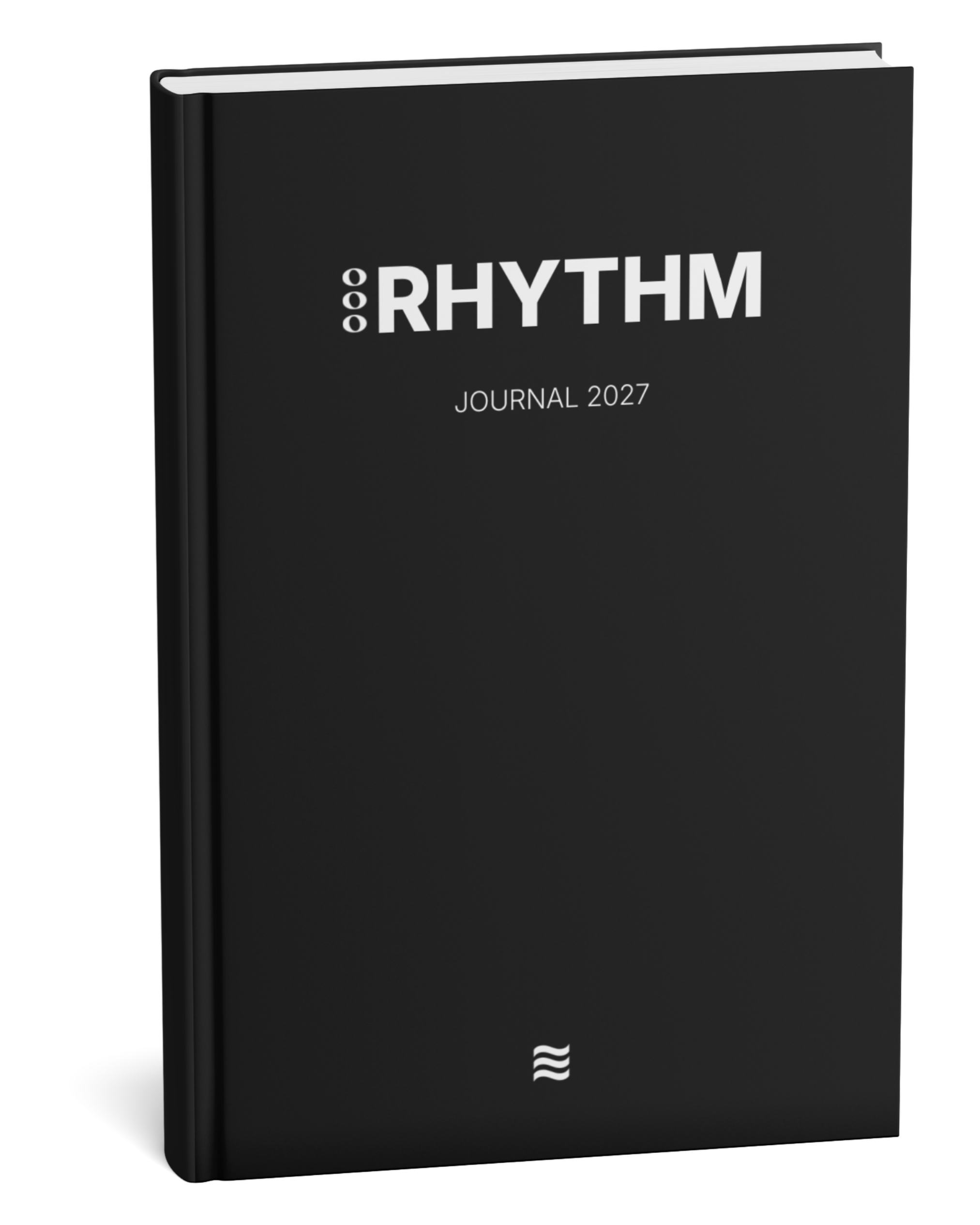
The RHYTHM Journal is a page-per-day journal with daily Bible readings taking you through the whole Bible, and questions to help you tune into the voice of God and put it into practice in your life.
Order your RHYTHM Journal here.
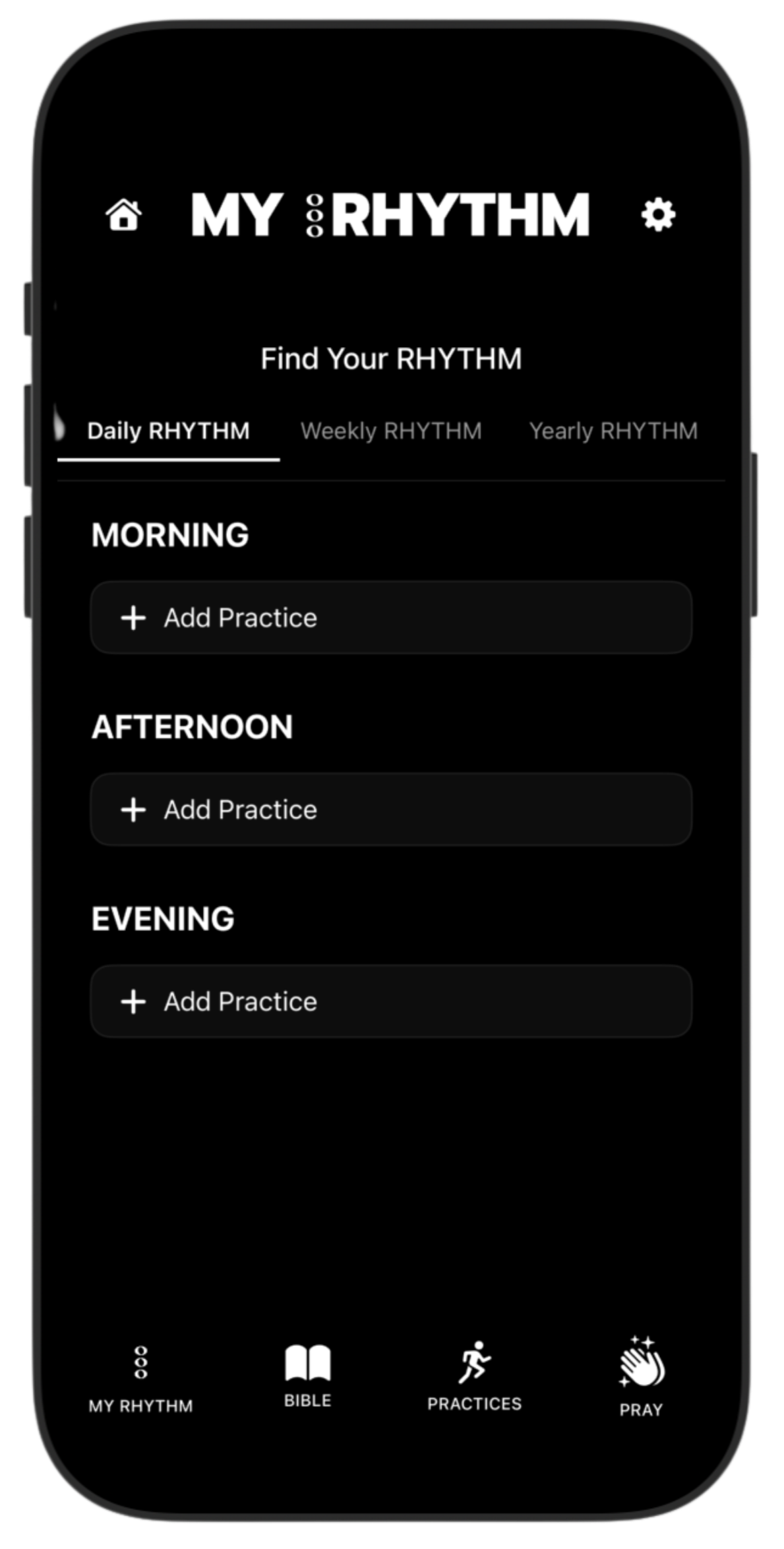
The RHYTHM App features a daily Bible reading plan, prayer journal, and a customisable ‘RHYTHM Builder’ which sends you reminders when its time to pray, read, fast, or get stuck into any other practice.
RHYTHM App coming soon!
RHYTHM Practices
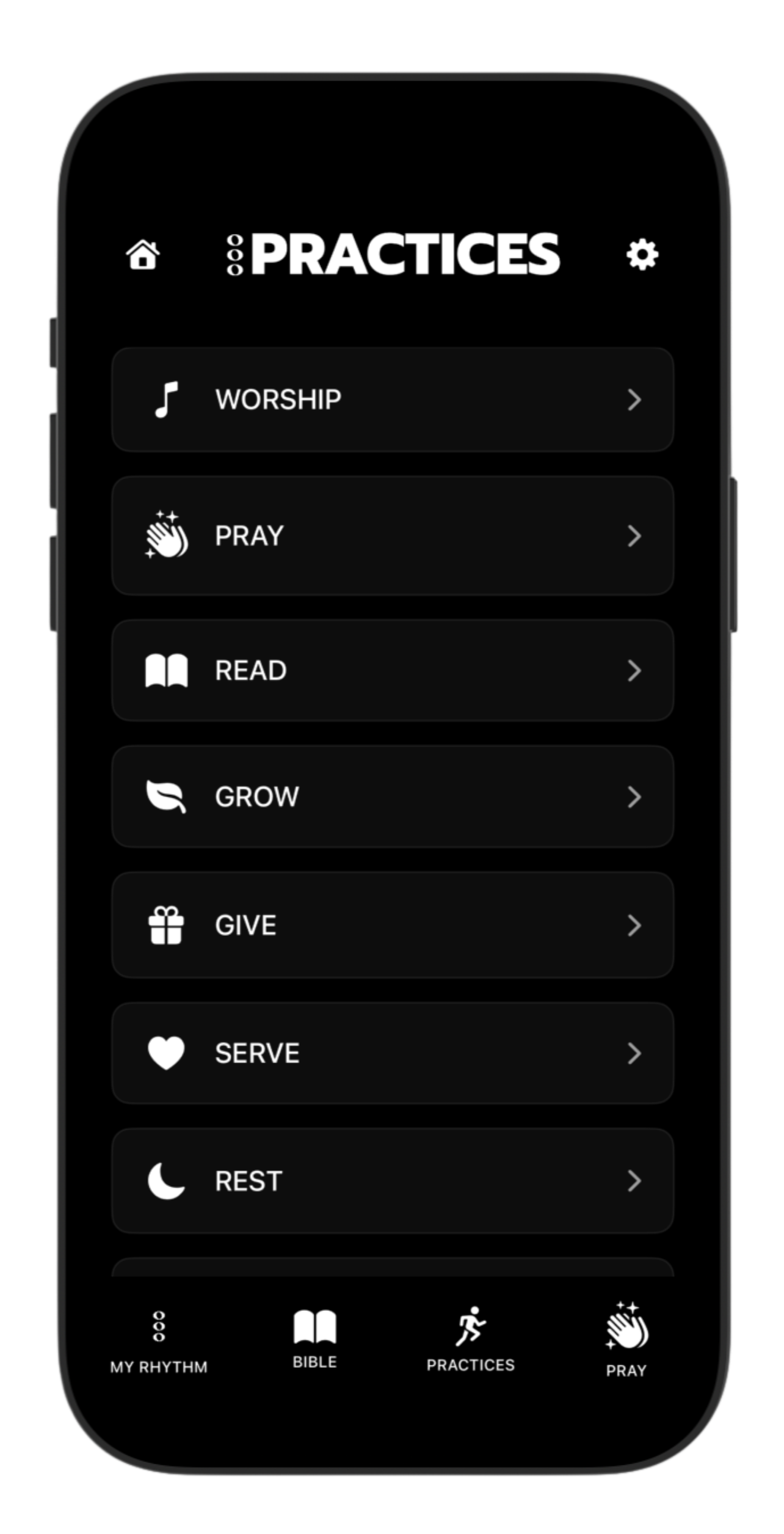
Our RHYTHMs are made up of ten core practices—spiritual disciplines which are central to the Christian faith, and deepen our discipleship to Jesus. Discover the practices here.
-
Jesus says the first command is to love God: in other words, to worship. Worship is the lifeblood of the Christian journey. When we worship, we declare and celebrate who God is and what He has done for us, and in doing so we set Him in His rightful place, at the very top of our priorities. But worship is also a very powerful act in which we encounter the presence of God.
There are as many ways to worship as there are people in the Church. It’s not so much about how we worship—the style or format—but what we worship “in Spirit and truth” (John 4:24).
Worship on Sundays
The primary act of worship is what we gather together as the Church to do each Sunday. Meeting with other followers of Jesus to worship is an essential part of the Christian life, and this practice needs to be something we all do on a weekly basis to sustain and strengthen our faith.
Music and More
Many people love to worship through music, singing God’s praises, and this is the most common expression of worship in the Bible, but there’s more to worship than singing. Liturgy—words, often poetic, which speak God’s praise—is another way to worship. Receiving Communion—bread and wine, blessed and shared—has been a central act of worship from the Church’s earliest days.
Worship at Home
As wonderful as it is to worship together in church, we can worship at home, too, whether in a small group or alone. Find some songs of worship on YouTube. Play some on Spotify in the car. These precious moments of celebration reconnect us to God, and recalibrate our priorities.
Digging Deeper
Why no seek our some fresh worship music to praise along to this week? Wings Music Group curate playlists with the latest Christians music on Spotify and Apple Music. And how about making one of our Sunday services at River Church a fixed part of your weekly worshipping RHYTHM? Find our all the details at river.church/sundays.
-
Prayer is conversation with God, and like any good conversation it involves both speaking and listening. We need to make space in our lives for regular, frequent prayer, sharing our thoughts, cares, and desires with the Lord, and listening for His voice guiding and directing us.
The Lord’s Prayer
Jesus taught us to pray what we now call ‘The Lord’s Prayer’. It goes like this:
Our Father in heaven, hallowed be your name, your kingdom come, your will be done, on earth as it is in heaven. Give us today our daily bread. And forgive us our debts, as we also have forgiven our debtors. And lead us not into temptation, but deliver us from the evil one. For the kingdom, the power, and the glory are yours, now and forever. Amen.
It’s a great idea to pray this prayer daily—we can’t improve upon Jesus’ own prayer!
Specific Prayers
As wonderful as the Lord’s Prayer is, it’s also good to bring more specific prayers to God. You could set aside specific things you’ll pray for on specific days (i.e., your family on Mondays, your friends of Tuesdays, your work on Wednesdays.) or keep a list of things you’re currently praying about.
Praying with Others
We read in Matthew 18, Jesus saying, “For where two or three gather in my name, there am I with them.” There is power in praying with others because Jesus promises He will be there too! This could look like coming to a prayer meeting at church, praying with your friends or family, or perhaps forming a small group of other Christians (something called a Prayer Triplet, if there are three of you!) to intentionally meet and pray with at regular intervals.
Praying Alone
Jesus often took time in the wilderness, alone, to pray, and He teaches us to find our own, private space for prayer too. When you are alone, you can focus your mind on God’s voice, free from distraction. You can pray in your head, in writing, out loud, or even in tongues—a powerful gift of the Holy Spirit.
Prayer Prompts
Sometimes memorable prompts can help us remember what to pray. TSP (think ‘teaspoon’) stands for ‘thank you, sorry, and please’. PRAY stands for ‘praise, repent, ask, and yield’. There are many more, and you can always create your own!
Prayer Journalling
Writing down our prayers can not only help us to concentrate on Jesus without getting distracted, but it creates a record of what we’ve been praying for to look back over. Each daily page in your RHYTHM Journal has space to jot down your prayers that day. Over time, look back at previous days’ prayers, give thanks to God for the ones you’ve seen answered, and reflect on those He’s not answered yet—sometimes we need to keep praying persistently for some time, and sometimes God answers in a way we weren’t expecting, or leads us in another direction. You can also use the Prayer Journal section on the RHYTHM App for this.
Digging Deeper
If you want to press into prayer and go deeper, take a look at 24-7 Prayer or Practicing the Way, who provide fantastic resources to inspire our prayer lives! And why not make weekly 7am Prayer or Overflow part of your RHYTHM if you’re part of River Church? Check our river.church/prayer.
-
Reading the Bible is like our daily bread—it feeds and sustains us. The Bible is God’s Word, authoritative and true, and is the ultimate guide for the Christian life. It’s incredible to think that we can hear God’s voice, on demand, by opening the pages of Scripture.
Daily Reading
Having a plan to guide us through reading the Bible every day is a core Christian practice, and your RHYTHM Journal gives you just that, with a Psalm or Proverb, an Old Testament passage, and a New Testament passage each day. You can read all three and this will take you through the whole Bible in a year, or focus on one section or another. You might find the acronym WRAP helpful as you approach the Bible: Welcome the Holy Spirit, asking Him to open up the Scriptures to you; Read the passage, making notes on what stands out and what you sense God saying; Apply the passage to your own life and decide how you’ll live aligned with the Bible that day; and Pray through the passage in response.
Reading Together
Reading the Bible with other Christians can be hugely life-giving, and can often open our eyes to parts of the Bible and perspectives we wouldn’t spot on our own. Why not meet a friend for a coffee and a Bible study on a regular basis?
Bible Study
The Bible is rich with meaning and there’s always more depths to plumb! If you’re particularly interested in a book or a passage, find a well regarded commentary—either in print or online—to read alongside it, which will give you insights into the context of that part of the Bible, the language used, and how that might affect its meaning.
Digging Deeper
One of the best resources for learning about the Bible available today is the Bible Project, whose videos and resources make learning about the Bible engaging and accessible. There are also copious resources on the YouVersion Bible App to help you engage with Scripture.
-
We grow when we are planted in community, and finding that community of people is often a pivotal moment in our journey of faith.
Join a Hangout
A Hangout (sometimes called a small group, connect group, or life group) is a group of Christians, usually 12-15, who meet together, regularly, to read the Bible together, pray for one another, and build community—often over a meal or a coffee! Hangouts meet in all sorts of places, from homes, to coffee shops, to workplaces, to gyms, and sometimes even churches! The people in our Hangouts spur us on towards Jesus, and build us up.
Digging Deeper
Most churches have Hangouts or similar groups available, but if yours doesn’t, why not start one? If you’re part of River Church then you can find a brilliant, local Hangout to join at river.church/hangouts.
-
Jesus calls all His followers to give financially as an act of worship to God—He doesn’t say, “If you give…” but “When you give…” so for Him it’s kind of assumed! But generosity is hard, and making it part of our RHYTHM helps us to grow in this area.
Give to your Local Church
Whichever church you are a part of, that is where you should start your journey of generosity. The Bible gives us a rule of thumb of 10% of our income as a good amount to give to God, but is also clear that even the tiniest amount can have a huge kingdom impact (10% of your income might be very different from somebody else’s). This might seem like a lot, but we need to remember that everything we have comes from God, and so giving a small portion back to Him is the least we can do, knowing that He will provide for our needs. Giving as a weekly, monthly, or yearly RHYTHM aligns our finances with our faith and breaks the power money can sometimes hold over us.
Giving Above and Beyond
Giving 10% to church (sometimes called tithing, which means ‘tenth’) isn’t the only way to give. As we grow more and more like Jesus who gave everything for us, we’ll see opportunities to grow our giving further. Perhaps you could help out a neighbour who is struggling financially with some meals or some shopping, or donate to a good cause in your local area? Studies show that giving is good for us, and generous people are often happy people, so I’m convinced that building giving into your RHYTHM will become something you enjoy!
Digging Deeper
If you want to discover more about giving as a spiritual practice, you could check our the Journey of Generosity online. If you haven’t already, why not setup regular giving at your local church, today, and if you are part of River Church, you can do that at river.church/give.
-
Jesus said that He didn’t come to be served, but to serve others, and as we become more like Jesus, we’ll want to serve others too. By giving our time and our talents in service of the Church, we are not only loving our neighbours, but we reap the benefits ourselves of knowing we’re making a difference, and becoming friends with those we serve alongside!
Acts of Kindness
Serving others doesn’t have to be organised or programmatic. Far from it. A beautiful part of our RHYTHM might be to live out a daily act of kindness—bringing someone a cup of tea, doing a task for them, or checking in to see how somebody going through a hard time is getting on. Daily habits like these form pathways in our brains, and before we know it, serving others like Jesus can become a deeply ingrained part of who we are, and kindness a core part of our character.
Joining a Team
The Holy Spirit gives each of us specific gifts, and yours will be different to everyone else’s. When we use our gifts to serve God and to serve others, three things happen. First, we glorify God by exercising the gifts He chose to give us. Second, we grow our gifts—just like how when we use a muscle, it grows and gets stronger! And third, it builds up the Church. Churches were designed to work when everybody offers their own gifts, and together we can achieve so much more than we can as individuals. Offering our gifts accelerates God’s kingdom coming through our local churches—so get stuck in!
Digging Deeper
Love Your Neighbour are a fantastic organisation, partnering with churches across the UK to serve communities and show kindness. They have inspiring resources to help you press into service. If you’re based at River Church, then why not sign up to serve monthly on a team at river.church/teams today?
-
Rest is a vital part of a sustainable RHYTHM. Did you know that we are actually commanded to rest in the Bible, and that even God Himself rested in creation?
Sabbath
As human beings we were created to work hard—whether that be in your job, your studies, your home, or your community—but not continuously! One day per week, take a day off, and use it to rest. As far as you are able, set that day aside for life-giving things like worship (if your day off is Sunday, then come to church!), time with loved ones, and other activities you enjoy, rather than work or things which need to be done. It can feel unnatural to rest, if you’re used to working all the time, but press through and experience God’s faithfulness as you honour Him with your time. We don’t need to be religious about Sabbath—sometimes life happens and there are exceptions to be made (even Jesus said so!)—but we should be rigorous about it. Take a break.
Digging Deeper
If you want to read more about Sabbath, John Mark Comer’s The Ruthless Elimination of Hurry is a great place to start. And practically, why not begin by blocking out some hours in your diary—and your weekly RHYTHM builder—for rest?
-
Fasting is one of the most important and most underrated spiritual practices in the Church, today! Sometimes we talk about fasting in Lent, which has become a tradition in the West, but fasting isn’t just for the lead up to Easter, it’s an everyday discipline for followers of Jesus.
Why Fast?
Fasting is going without food or drink for a period of time, to help us focus our prayers and attune ourselves to God’s voice through the Holy Spirit. The idea is that by cutting out the distraction of food, we can pay more attention to God’s voice, and that each time we are hungry we are reminded to pray. We see in the Bible that there are some miracles which can only happen through prayer and fasting, so fasting clearly carries significant spiritual power! Got a big decision to make? Fast. Seeking something specific in prayer? Fast. Contending for revival in your generation? Fast. You get the picture.
Fasting and Abstinence
Abstinence is a similar spiritual practice, which involves going without something other than food or drink (such as social media, TV, spending, or other luxuries) for a while to achieve a similar end—focus in prayer and connection with God. If there are medical or practical reasons why fasting is not a good idea (and please take medical advice before fasting if that is relevant to you!) then abstinence can be a great substitute.
Digging Deeper
Practicing the Way have some great input on fasting, but why not remind yourself of some key stories about fasting in the Bible about fasting like Daniel 1 and 10, or Matthew 6? How about trying to fast (or abstain), even for part of a day, as one of your weekly or yearly RHYTHMs?
-
We see Jesus retreating in the Bible on multiple occasions, including before the start of His ministry. Retreat involves a time of solitude—stepping away for a time from the business of everyday life, the people around us, and our usual geographical location—in order to intentionally spend time in the presence of God.
How to Retreat?
Retreat is a practice which is flexible, and it will look different for each of us. For some, you might be able to take a full week away, once per year, to get away from it all and seek the Lord. For others, perhaps if you having caring responsibilities, this would be unrealistic, but a day or half a day out in nature might prove just as fruitful. You could go away to a retreat centre or monastery, find a cosy corner of a coffee shop, or sit on a park bench in the great outdoors. It doesn’t matter where you or, or how long for, just that your daily distractions are stripped away enough to give you space to become aware of the presence of the Holy Spirit. If you find it tricky to do this on your own, there are some great guided retreat out there which help you along the way.
What is a retreat for?
A retreat isn’t primarily about rest—that is what Sabbath is for. And a retreat isn’t about hearing God’s voice and direction, seeking the power of the Spirit, or getting results in prayer. That’s fasting’s role. Retreat is about being undistracted in the presence of God. It’s being with God because being with Him is enough in itself. Now, you will likely find that you do hear from God, or discover breakthrough, or feel rested after retreating, but those are just bonuses—the real business is being with Jesus.
Digging Deeper
Retreat is, for most people, best used as part of our yearly RHYTHM. Maybe look several months ahead and get a day, a couple of days, or even half a day in your diary to try a retreat. If you’re in Suffolk, then you could head to one of our many beautiful countryside spots, or check out some brilliant, local retreat centres like Sizewell Hall, The Place By The Water, or Quiet Waters.
-
The Good News of Jesus is simply too good to keep to ourselves. We are called to ‘make disciples’ which means to tell other people about Jesus, and help them to follow Him and be saved as a result. Invitation isn’t an optional extra for keen bean Christians, it’s an essential ingredient to a healthy RHYTHM of following Jesus. But this doesn’t have to be complicated of scary—you don’t have to preach to everyone you meet, or share your entire story of the difference Jesus has made to you. Often Jesus and his first followers simply said, ‘Come and see’. Inviting a friend, family member, or colleague to come to church or to Alpha—somewhere they can experience Jesus and hear the Gospel for themselves—is a simple and easy way to live obediently as Christians. How could aiming to invite somebody along every week or every month as part of your RHYTHM transform the impact your life has on others?
Digging Deeper
Who could you invite? This is a great question to ask the Lord in prayer. For ideas and resources to help you with invitation, check out Alpha. And if you’re local, why not send a friend a link to river.church/alpha and say ‘Come and see’.
RHYTHM Daily Bible Readings
As you approach today’s Bible readings, remember to WRAP: Welcome the Holy Spirit and ask Him to speak to you through the passages; Read through the Scriptures and see what stands out to you; Apply what you have read to your own life and circumstances; and Pray in response to what you’ve been reading. Let God’s voice speak into your life, today!
Loading today's readings...
Loading passage...